NSE7_SOC_AR-7.6試験情報 & NSE7_SOC_AR-7.6復習内容
Wiki Article
ちなみに、Xhs1991 NSE7_SOC_AR-7.6の一部をクラウドストレージからダウンロードできます:https://drive.google.com/open?id=1P0gz9WvWhOE-kAXWrfbDd7SkDFpQYSt_
NSE7_SOC_AR-7.6試験はあなたのキャリアのマイルストーンで、競争が激しいこの時代で、これまで以上に重要になりました。あなたは一回で気楽にNSE7_SOC_AR-7.6試験に合格することを保証します。将来で新しいチャンスを作って、仕事が楽しげにやらせます。Xhs1991の値段よりそれが創造する価値ははるかに大きいです。我々は弊社の商品とあなたの努力を通してあなたはNSE7_SOC_AR-7.6試験に合格することができると信じています。
Fortinet NSE7_SOC_AR-7.6 認定試験の出題範囲:
| トピック | 出題範囲 |
|---|---|
| トピック 1 |
|
| トピック 2 |
|
| トピック 3 |
|
| トピック 4 |
|
Fortinet NSE7_SOC_AR-7.6復習内容、NSE7_SOC_AR-7.6実際試験
Xhs1991はIT認定試験を受験した多くの人々を助けました。また、受験生からいろいろな良い評価を得ています。Xhs1991のNSE7_SOC_AR-7.6問題集の合格率が100%に達することも数え切れない受験生に証明された事実です。もし試験の準備をするために大変を感じているとしたら、ぜひXhs1991のNSE7_SOC_AR-7.6問題集を見逃さないでください。これは試験の準備をするために非常に効率的なツールですから。この問題集はあなたが少ない労力で最高の結果を取得することができます。
Fortinet NSE 7 - Security Operations 7.6 Architect 認定 NSE7_SOC_AR-7.6 試験問題 (Q53-Q58):
質問 # 53
According to the National Institute of Standards and Technology (NIST) cybersecurity framework, incident handling activities can be divided into phases.
In which incident handling phase do you quarantine a compromised host in order to prevent an adversary from using it as a stepping stone to the next phase of an attack?
- A. Eradication
- B. Containment
- C. Recovery
- D. Analysis
正解:B
解説:
* NIST Cybersecurity Framework Overview:
* The NIST Cybersecurity Framework provides a structured approach for managing and mitigating cybersecurity risks. Incident handling is divided into several phases to systematically address and resolve incidents.
* Incident Handling Phases:
* Preparation: Establishing and maintaining an incident response capability.
* Detection and Analysis: Identifying and investigating suspicious activities to confirm an incident.
* Containment, Eradication, and Recovery:
* Containment: Limiting the impact of the incident.
* Eradication: Removing the root cause of the incident.
* Recovery: Restoring systems to normal operation.
* Containment Phase:
* The primary goal of the containment phase is to prevent the incident from spreading and causing further damage.
* Quarantining a Compromised Host:
* Quarantining involves isolating the compromised host from the rest of the network to prevent adversaries from moving laterally and causing more harm.
* Techniques include network segmentation, disabling network interfaces, and applying access controls.
Reference: NIST Special Publication 800-61, "Computer Security Incident Handling Guide"NIST Incident Handling Detailed Process:
Step 1: Detect the compromised host through monitoring and analysis.
Step 2: Assess the impact and scope of the compromise.
Step 3: Quarantine the compromised host to prevent further spread. This can involve disconnecting the host from the network or applying strict network segmentation.
Step 4: Document the containment actions and proceed to the eradication phase to remove the threat completely.
Step 5: After eradication, initiate the recovery phase to restore normal operations and ensure that the host is securely reintegrated into the network.
Importance of Containment:
Containment is critical in mitigating the immediate impact of an incident and preventing further damage. It buys time for responders to investigate and remediate the threat effectively.
Reference: SANS Institute, "Incident Handler's Handbook" SANS Incident Handling References:
NIST Special Publication 800-61, "Computer Security Incident Handling Guide" SANS Institute, "Incident Handler's Handbook" By quarantining a compromised host during the containment phase, organizations can effectively limit the spread of the incident and protect their network from further compromise.
質問 # 54
Which statement best describes the MITRE ATT&CK framework?
- A. It provides a high-level description of common adversary activities, but lacks technical details
- B. It describes attack vectors targeting network devices and servers, but not user endpoints.
- C. It contains some techniques or subtechniques that fall under more than one tactic.
- D. It covers tactics, techniques, and procedures, but does not provide information about mitigations.
正解:C
解説:
* Understanding the MITRE ATT&CK Framework:
* The MITRE ATT&CK framework is a comprehensive matrix of tactics and techniques used by adversaries to achieve their objectives.
* It is widely used for understanding adversary behavior, improving defense strategies, and conducting security assessments.
* Analyzing the Options:
* Option A:The framework provides detailed technical descriptions of adversary activities, including specific techniques and subtechniques.
* Option B:The framework includes information about mitigations and detections for each technique and subtechnique, providing comprehensive guidance.
* Option C:MITRE ATT&CK covers a wide range of attack vectors, including those targeting user endpoints, network devices, and servers.
* Option D:Some techniques or subtechniques do indeed fall under multiple tactics, reflecting the complex nature of adversary activities that can serve different objectives.
* Conclusion:
* The statement that best describes the MITRE ATT&CK framework is that it contains some techniques or subtechniques that fall under more than one tactic.
References:
MITRE ATT&CK Framework Documentation.
Security Best Practices and Threat Intelligence Reports Utilizing MITRE ATT&CK.
質問 # 55
Refer to the exhibit.
You notice that the custom event handler you configured to detect SMTP reconnaissance activities is creating a large number of events. This is overwhelming your notification system.
How can you fix this?
- A. Increase the log field value so that it looks for more unique field values when it creates the event.
- B. Decrease the time range that the custom event handler covers during the attack.
- C. Disable the custom event handler because it is not working as expected.
- D. Increase the trigger count so that it identifies and reduces the count triggered by a particular group.
正解:D
解説:
* Understanding the Issue:
* The custom event handler for detecting SMTP reconnaissance activities is generating a large number of events.
* This high volume of events is overwhelming the notification system, leading to potential alert fatigue and inefficiency in incident response.
* Event Handler Configuration:
* Event handlers are configured to trigger alerts based on specific criteria.
* The frequency and volume of these alerts can be controlled by adjusting the trigger conditions.
* Possible Solutions:
* A. Increase the trigger count so that it identifies and reduces the count triggered by a particular group:
* By increasing the trigger count, you ensure that the event handler only generates alerts after a higher threshold of activity is detected.
* This reduces the number of events generated and helps prevent overwhelming the notification system.
* Selected as it effectively manages the volume of generated events.
* B. Disable the custom event handler because it is not working as expected:
* Disabling the event handler is not a practical solution as it would completely stop monitoring for SMTP reconnaissance activities.
* Not selected as it does not address the issue of fine-tuning the event generation.
* C. Decrease the time range that the custom event handler covers during the attack:
* Reducing the time range might help in some cases, but it could also lead to missing important activities if the attack spans a longer period.
* Not selected as it could lead to underreporting of significant events.
* D. Increase the log field value so that it looks for more unique field values when it creates the event:
* Adjusting the log field value might refine the event criteria, but it does not directly control the volume of alerts.
* Not selected as it is not the most effective way to manage event volume.
* Implementation Steps:
* Step 1: Access the event handler configuration in FortiAnalyzer.
* Step 2: Locate the trigger count setting within the custom event handler for SMTP reconnaissance.
* Step 3: Increase the trigger count to a higher value that balances alert sensitivity and volume.
* Step 4: Save the configuration and monitor the event generation to ensure it aligns with expected levels.
* Conclusion:
* By increasing the trigger count, you can effectively reduce the number of events generated by the custom event handler, preventing the notification system from being overwhelmed.
Fortinet Documentation on Event Handlers and Configuration FortiAnalyzer Administration Guide Best Practices for Event Management Fortinet Knowledge Base By increasing the trigger count in the custom event handler, you can manage the volume of generated events and prevent the notification system from being overwhelmed.
質問 # 56
Refer to the exhibit.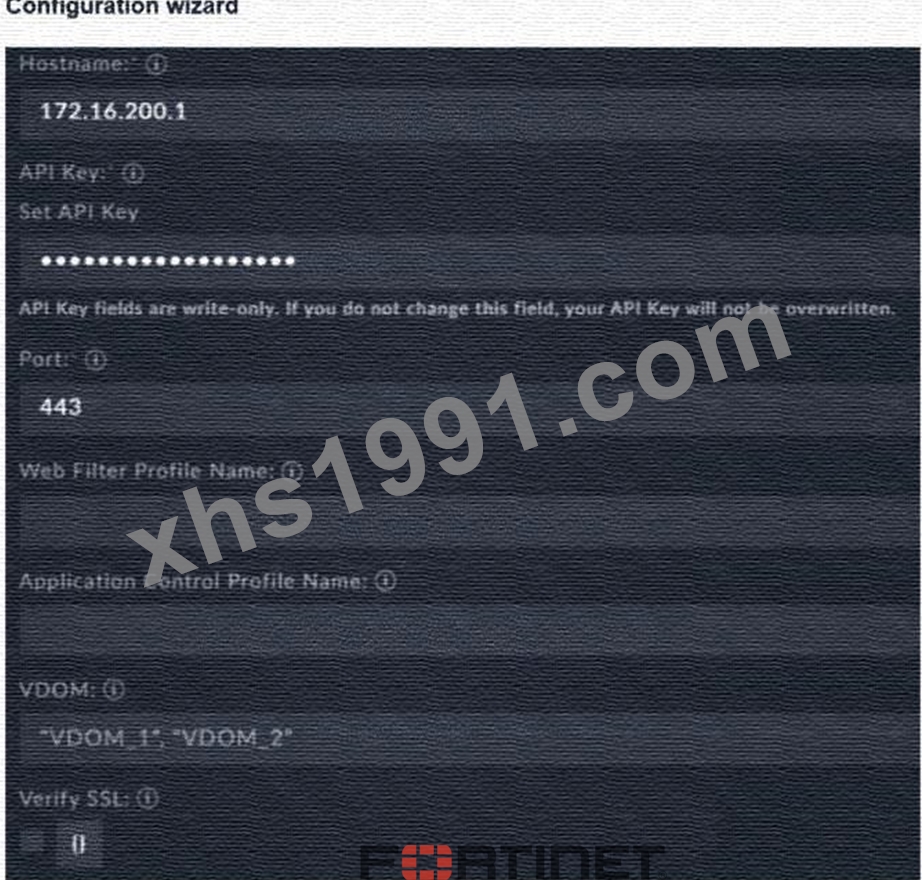
You must configure the FortiGate connector to allow FortiSOAR to perform actions on a firewall. However, the connection fails. Which two configurations are required? (Choose two answers)
- A. The VDOM name must be specified, or set to VDOM_1, if VDOMs are not enabled on FortiGate.
- B. An API administrator must be created on FortiGate with the appropriate profile, along with a generated API key to configure on the connector.
- C. Trusted hosts must be enabled and the FortiSOAR IP address must be permitted.
- D. HTTPS must be enabled on the FortiGate interface that FortiSOAR will communicate with.
正解:B、D
解説:
Comprehensive and Detailed Explanation From FortiSOAR 7.6., FortiSIEM 7.3 Exact Extract study guide:
To establish a successful integration betweenFortiSOAR 7.6and aFortiGatefirewall via the FortiGate connector, specific administrative and network requirements must be met on the FortiGate side:
* API Administrator and Key (D):FortiSOAR does not use standard UI login credentials. Instead, it requires aREST API Administratoraccount to be created on the FortiGate. This account must be assigned an administrative profile with the necessary permissions (e.g., Read/Write for Firewall policies or Address objects). Upon creation, the FortiGate generates a uniqueAPI Key, which must be entered into the "API Key" field of the FortiSOAR configuration wizard as shown in the exhibit.
* HTTPS Management Access (C):The connector communicates with the FortiGate using REST API calls overHTTPS(port 443 by default). Therefore, the physical or logical interface on the FortiGate that corresponds to the "Hostname" IP (172.16.200.1) must haveHTTPSenabled under "Administrative Access" in its network settings. If HTTPS is disabled, the connection will time out or be refused.
Why other options are incorrect:
* Trusted hosts (A):While it is a best practice to restrict API access to specific IPs (like the FortiSOAR IP), the integration can technically function without "Trusted hosts" enabled if the network allows the traffic. However, theabsenceof an API key or HTTPS access will definitively cause a failure regardless of trusted host settings.
* VDOM name (B):In the exhibit, the VDOM field contains multiple values ("VDOM_1", "VDOM_2").
If VDOMs are disabled on the FortiGate, this field should generally be left blank or set to the default
"root." Setting it specifically to "VDOM_1" when VDOMs are disabled is not a universal requirement for connectivity; the primary handshake depends on the API key and HTTPS connectivity.
質問 # 57
Refer to the exhibits.
You configured a custom event handler and an associated rule to generate events whenever FortiMail detects spam emails. However, you notice that the event handler is generating events for both spam emails and clean emails.
Which change must you make in the rule so that it detects only spam emails?
- A. In the Trigger an event when field, select Within a group, the log field Spam Name (snane) has 2 or more unique values.
- B. In the Log Type field, select Anti-Spam Log (spam)
- C. Disable the rule to use the filter in the data selector to create the event.
- D. In the Log filter by Text field, type type==spam.
正解:B
解説:
* Understanding the Custom Event Handler Configuration:
* The event handler is set up to generate events based on specific log data.
* The goal is to generate events specifically for spam emails detected by FortiMail.
* Analyzing the Issue:
* The event handler is currently generating events for both spam emails and clean emails.
* This indicates that the rule's filtering criteria are not correctly distinguishing between spam and non-spam emails.
* Evaluating the Options:
* Option A:Selecting the "Anti-Spam Log (spam)" in the Log Type field will ensure that only logs related to spam emails are considered. This is the most straightforward and accurate way to filter for spam emails.
* Option B:Typing type==spam in the Log filter by Text field might help filter the logs, but it is not as direct and reliable as selecting the correct log type.
* Option C:Disabling the rule to use the filter in the data selector to create the event does not address the issue of filtering for spam logs specifically.
* Option D:Selecting "Within a group, the log field Spam Name (snane) has 2 or more unique values" is not directly relevant to filtering spam logs and could lead to incorrect filtering criteria.
* Conclusion:
* The correct change to make in the rule is to select "Anti-Spam Log (spam)" in the Log Type field. This ensures that the event handler only generates events for spam emails.
References:
Fortinet Documentation on Event Handlers and Log Types.
Best Practices for Configuring FortiMail Anti-Spam Settings.
質問 # 58
......
Xhs1991がもっと早くFortinetのNSE7_SOC_AR-7.6認証試験に合格させるサイトで、FortinetのNSE7_SOC_AR-7.6認証試験についての問題集が市場にどんどん湧いてきます。あなたがまだ専門知識と情報技術を証明しています強い人材で、Xhs1991のFortinetのNSE7_SOC_AR-7.6認定試験について最新の試験問題集が君にもっとも助けていますよ。
NSE7_SOC_AR-7.6復習内容: https://www.xhs1991.com/NSE7_SOC_AR-7.6.html
- 信頼できるNSE7_SOC_AR-7.6試験情報 - 資格試験におけるリーダーオファー - すぐにダウンロードNSE7_SOC_AR-7.6: Fortinet NSE 7 - Security Operations 7.6 Architect ✳ 【 www.passtest.jp 】にて限定無料の「 NSE7_SOC_AR-7.6 」問題集をダウンロードせよNSE7_SOC_AR-7.6試験勉強過去問
- 正確的なFortinet NSE7_SOC_AR-7.6試験情報 - 合格スムーズNSE7_SOC_AR-7.6復習内容 | 素晴らしいNSE7_SOC_AR-7.6実際試験 ???? ⏩ www.goshiken.com ⏪の無料ダウンロード⏩ NSE7_SOC_AR-7.6 ⏪ページが開きますNSE7_SOC_AR-7.6的中合格問題集
- NSE7_SOC_AR-7.6日本語受験教科書 ???? NSE7_SOC_AR-7.6難易度受験料 ???? NSE7_SOC_AR-7.6日本語受験教科書 ???? 今すぐ☀ www.goshiken.com ️☀️で▛ NSE7_SOC_AR-7.6 ▟を検索して、無料でダウンロードしてくださいNSE7_SOC_AR-7.6試験問題
- 信頼的なNSE7_SOC_AR-7.6試験情報 - 合格スムーズNSE7_SOC_AR-7.6復習内容 | 権威のあるNSE7_SOC_AR-7.6実際試験 Fortinet NSE 7 - Security Operations 7.6 Architect ???? URL ➽ www.goshiken.com ????をコピーして開き、“ NSE7_SOC_AR-7.6 ”を検索して無料でダウンロードしてくださいNSE7_SOC_AR-7.6資格問題対応
- 信頼できるNSE7_SOC_AR-7.6試験情報 - 資格試験におけるリーダーオファー - すぐにダウンロードNSE7_SOC_AR-7.6: Fortinet NSE 7 - Security Operations 7.6 Architect ???? ➤ www.mogiexam.com ⮘に移動し、⏩ NSE7_SOC_AR-7.6 ⏪を検索して無料でダウンロードしてくださいNSE7_SOC_AR-7.6日本語版参考資料
- 信頼的なNSE7_SOC_AR-7.6試験情報 - 合格スムーズNSE7_SOC_AR-7.6復習内容 | 権威のあるNSE7_SOC_AR-7.6実際試験 Fortinet NSE 7 - Security Operations 7.6 Architect ⏸ ▷ www.goshiken.com ◁から簡単に➠ NSE7_SOC_AR-7.6 ????を無料でダウンロードできますNSE7_SOC_AR-7.6試験勉強過去問
- NSE7_SOC_AR-7.6無料過去問 ⛵ NSE7_SOC_AR-7.6無料過去問 ❣ NSE7_SOC_AR-7.6資格問題対応 ???? ⏩ www.xhs1991.com ⏪に移動し、( NSE7_SOC_AR-7.6 )を検索して無料でダウンロードしてくださいNSE7_SOC_AR-7.6日本語版参考資料
- NSE7_SOC_AR-7.6試験の準備方法|更新するNSE7_SOC_AR-7.6試験情報試験|認定するFortinet NSE 7 - Security Operations 7.6 Architect復習内容 ???? ウェブサイト➠ www.goshiken.com ????から【 NSE7_SOC_AR-7.6 】を開いて検索し、無料でダウンロードしてくださいNSE7_SOC_AR-7.6日本語講座
- NSE7_SOC_AR-7.6試験解説問題 ???? NSE7_SOC_AR-7.6試験問題 ???? NSE7_SOC_AR-7.6日本語版参考資料 ???? 《 www.passtest.jp 》サイトにて☀ NSE7_SOC_AR-7.6 ️☀️問題集を無料で使おうNSE7_SOC_AR-7.6最新問題
- 有難い-実際的なNSE7_SOC_AR-7.6試験情報試験-試験の準備方法NSE7_SOC_AR-7.6復習内容 ???? ▷ www.goshiken.com ◁で使える無料オンライン版➽ NSE7_SOC_AR-7.6 ???? の試験問題NSE7_SOC_AR-7.6認定資格試験
- 信頼できるNSE7_SOC_AR-7.6試験情報 - 資格試験におけるリーダーオファー - すぐにダウンロードNSE7_SOC_AR-7.6: Fortinet NSE 7 - Security Operations 7.6 Architect ???? 最新☀ NSE7_SOC_AR-7.6 ️☀️問題集ファイルは⮆ www.mogiexam.com ⮄にて検索NSE7_SOC_AR-7.6日本語版サンプル
- pukkabookmarks.com, blanchelzeh403872.vidublog.com, socialwebleads.com, aishahxvi681980.nizarblog.com, bookmarks4seo.com, myandci058475.topbloghub.com, gregoryvkes219370.ssnblog.com, jimverj783170.losblogos.com, prestonelnw559423.celticwiki.com, bookmarktiger.com, Disposable vapes
無料でクラウドストレージから最新のXhs1991 NSE7_SOC_AR-7.6 PDFダンプをダウンロードする:https://drive.google.com/open?id=1P0gz9WvWhOE-kAXWrfbDd7SkDFpQYSt_
Report this wiki page